
Meeting Logistics
Date: Thursday, October 22, 2026
Time: 6:00 p.m. Check-in / Social Hour
…………6:30 p.m. Dinner
………..7:00 p.m. Speaker Presentations
Location: ACS Headquarters, Marvel Hall
…………. 1155 16th Street, NW, Washington, DC 20036
Menu: Meal will be catered by W. Millar and will feature Cuban mojo Chicken Breast, Rum glazed Flank Steak, Citrus-seared tuna, Freshly baked bread board, cookies & bars. Beverages are included.
Vegetarian option available by request only: Thai Veggie Skewers.
Cost: $26 (1/2 price for students and high school teachers)
An RSVP is required for dinner so we can plan appropriate seating and meals. Deadline to register is Noon Tuesday, October 20.
Registration is required if you wish to participate virtually via Zoom –
https://american-chemical-society.zoom.com/meeting/register/xpjiNgK9S0CmSpbFRYEuKA?visitorGuid=477b1a73547c40d29ab319fb5b361780
RSVP by Noon (ET) Tuesday, October 20, to csw@acs.org. Please provide the names in your party as well as your contact information when you RSVP. The public is invited to attend. You may attend the talk only at no charge, but reservations are appreciated. If you need any further information or would like to make a reservation, please contact the CSW office by email at csw@acs.org.
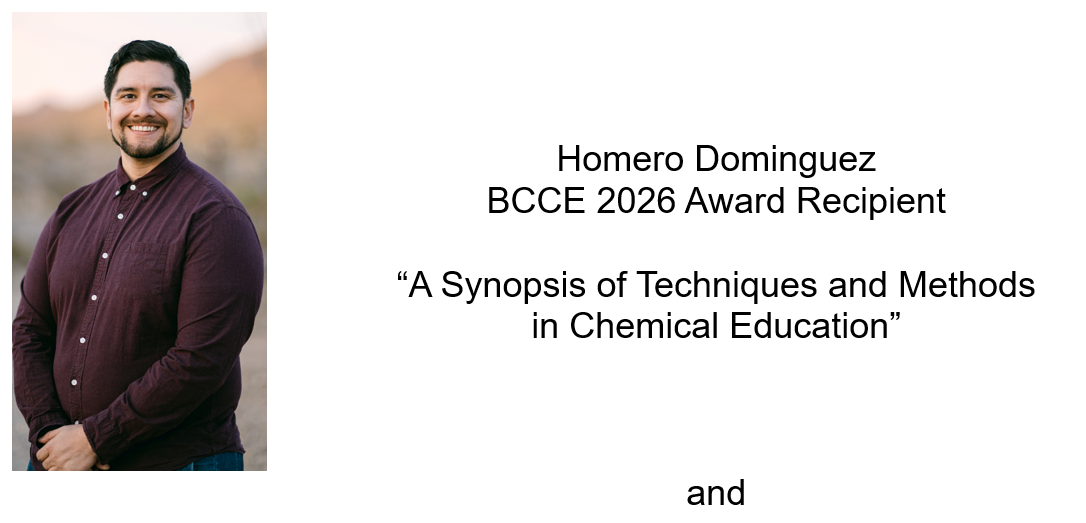
Bio: Homero Dominguez
Homero was born and raised in El Paso, Texas. He went to UT Austin for his undergraduate degree in Biochemistry and University of Notre Dame for his masters degree in Chemistry. He is currently in his third year teaching at West Springfield High School in Springfield, Virginia. He teaches general and honors chemistry. Homero has taken a liking to teaching since college, where he served as an undergraduate teaching assistant for general chemistry classes. During his time in graduate school, he won the graduate student teaching award, which is given to 3% of the department. He was also able to publish as a first author in peer-reviewed work under the guidance of Dr. Shahriar Mobashery, a leader in antibiotic development that targets the cell wall. After graduate school, Homero worked briefly in industry before making the switch to teaching. Homero is interested in finding new methods to engage and foster better understanding in a high school setting. He recently connected and learned with many educators during his time at the Biennial Conference on Chemical Education. Outside of the Chemistry Classroom, Homero enjoys spending time with his wife and friends, resistance training, playing tennis, swimming, playing flute, and going to concerts!
Abstract: A Synopsis of Techniques and Methods in Chemical Education
The fundamental content of chemistry remains consistent across educational contexts and geographic settings; however, the ways in which chemistry is presented and experienced can substantially influence student learning and engagement. This presentation draws on four learning experiences and emerging ideas from BCCE 2026 that have implications for chemistry teaching across secondary and post-secondary education: integrating General Chemistry I and II to strengthen curricular coherence, incorporating metacognitive micro-practices to support student learning, fostering inclusive and engaging classroom experiences, and connecting chemistry learning with local communities and real-world contexts.
Together, these approaches highlight opportunities to reconsider how chemistry is taught, learned, and connected to broader educational and societal contexts. The goal of this presentation is to bring together chemistry educators, education researchers, and practitioners to exchange ideas, examine innovative approaches to chemistry education, and build collaborative connections that can inform teaching and learning across educational settings.
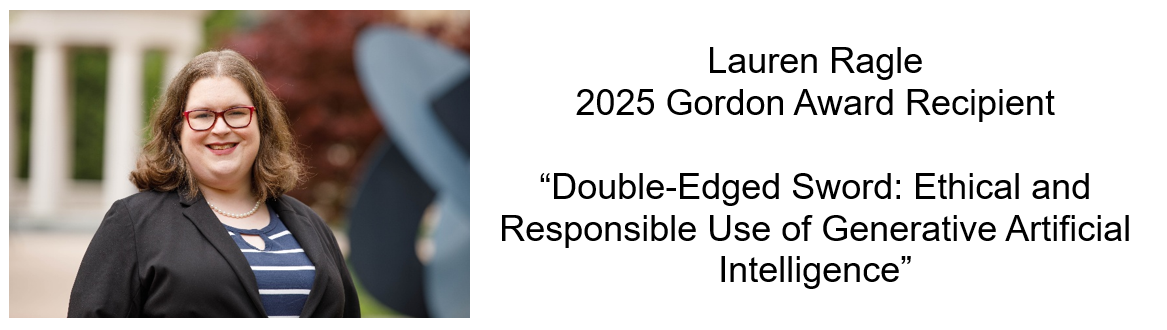
Bio: Lauren Ragle
Dr. Lauren Ragle is a Professor of Organic Chemistry and Biochemistry at George Washington University and the recipient of CSW’s 2025 Gordon Award. She was born and raised in Memphis, TN where she was a first-generation bachelor’s graduate of the Chemistry Department at the University of Memphis in 2011. Lauren stayed on for graduate school, studying bioactive lipid signaling to earn her Ph.D. in Organic Chemistry in 2016. From there, she served as a CRTA Postdoctoral Fellow at the National Cancer Institute before launching her faculty career in 2020. Driven by a love for scientific discovery and mentorship, Dr. Ragle works to make STEM education more accessible and supportive for all students. When she isn’t teaching or mentoring in the lab, you can find her leading local community outreach initiatives or working on craft projects at her neighborhood makerspace in Loudoun County.
Abstract: Double-Edged Sword: Ethical and Responsible Use of Generative Artificial Intelligence
The sudden ubiquity of generative artificial intelligence (genAI) has sent shockwaves through the scientific and educational enterprises. While early organizational responses often defaulted to institutional anxiety or absolute bans, a deeper look reveals that genAI is neither purely a utopian savior nor a dystopian shortcut. In this presentation, we explore the “double-edged sword” of genAI through the practical lens of postbaccalaureate premedical chemistry education, demonstrating how we can leverage these tools to drive student-led innovation while protecting vulnerable populations.
Using personal case studies—ranging from how a busy faculty member optimizes administrative workflows to create time for systemic community service, to how a student engineered an interactive, gamified AI bot to scaffold complex metabolic pathways—we will look past the digital screen to see the true human element of computing. We will critically evaluate the “helps” of cognitive scaffolding alongside the hidden “hurts,” including the technical flaws of automated plagiarism detectors that disproportionately misclassify neurodivergent student syntax, and the real-world infrastructure strains placed on our local Northern Virginia power grids. Ultimately, this talk moves beyond reactionary tech panic to offer a unified vision for the future of our field. A vision where our shared definition of scientific integrity safeguards human authenticity, centers classroom equity, and ensures our future scientists are always sharper than the algorithms they use.
Parking: Parking is available in nearby commercial parking garages. Please be aware that garage closing times vary. Parking is also available on the street after 6:30 pm, but be aware that most parking meters are in effect until 10:00 pm and may be limited to 2 hours. You should check the individual meters for details and payment methods as some are no longer coin-operated.
Metro: Blue/Orange/Silver Line: McPherson Square or Farragut West.
Red Line: Farragut North